EFN Newsletter February 2026 #39
Tell us something: aren’t you following us on social media yet? You’re missing out on a lot! We’re very active on Facebook and Instagram.
WELCOME AND SUMMARY
Welcome to the new edition of this communication and outreach initiative of the EFN. Feel free to forward it to your friends and colleagues. Receiving this newsletter is open to anyone for free, here. Read to the end to find out how to submit content for future editions.
This is what you'll find below:
🔹News from EFN:
▫️Farewell to Erasmo Treglia
▫️EFN and members, in Babel Music XP: special opportunity. Reminder
▫️Tradition in Motion: Celebrating 30 Years of Traditional Music at Scotland’s National Conservatoire
🔸New members:
▫️Désirée Saarela-Portin, Finland-Swedish artist
▫️Martina Menichetti, artist name Authentica, from Luxembourg
🔹News from the members:
▫️Nordic Folk Alliance 2026 will take place in Malmö, Sweden, on 9–11 April
▫️Flanders Folk Awards and Belgian Worlwide Music Awards
▫️WOMEX: Call for Proposals 2026
▫️Ethno Mobility Call 2026 – Applications Now Open
▫️Duo Kurbasy, from Lviv: masterclass on Ukrainian Polyphonics and lecture concert in HEM Geneva
🔸Our next featured member is Compagnie Macke-Bornauw
🔹Our next featured artist is the Galician singer and multi-instrumentalist Mercedes Peón
🔸Special content: Interview about the debut album by Kyiv's Kapela Zbyten
✍️ Do you want to participate? At the end of the newsletter you will find how you can contribute to future editions, whether you are an EFN member or not.
And of course EFN is always looking for new members and at the end of this newsletter there is a note about how and why to join, with links to the membership pages of the website and the application form.
News from EFN
🔸Farewell to Erasmo Treglia

On 24 January, the sad news spread through the professional folk and world music community, as well as among many enthusiasts, of the passing of Erasmo Treglia. Several members of the EFN board and many of our members knew and appreciated Erasmo, and we would like to remember him here with a brief obituary based on the one published in Italian by Rai News. The picture is credited for Finisterre, Erasmo's label.
~~~
Erasmo Treglia, who passed away at the age of 65, was a leading figure in Italian ethnomusicology and traditional music. Born in Maranola, near Formia (Latina), he dedicated his life to the research, performance, recording and promotion of oral musical traditions, particularly in Lazio. A student of Diego Carpitella at Sapienza University of Rome, he carried forward important fieldwork and scholarship, including a notable 1988 study on therapeutic violin music in Apulian tarantism.
Together with Ambrogio Sparagna, he co-founded the Festival della Zampogna in Maranola, which became one of Europe’s key gatherings for traditional music and innovation. A versatile multi-instrumentalist — playing hurdy-gurdy, violin, trumpet, ciaramella and Swedish keyed harp — he also founded the group Acquaragia Drom and, through his label Finisterre, supported numerous projects, recordings and artistic exchanges. The Fondazione Musica per Roma described him as an “unparalleled cultural animator.”
~~
Erasmo Treglia leaves behind not only music and scholarship, but a living network of sounds, friendships and shared memory that will continue to resonate across the European folk community.
🔸EFN and members, in Babel Music XP: special opportunity
REMINDER

The EFN will be present at Babel Music XP in Marseille, 19-21 March 2026. The organization agreed to provide an opportunity for EFN members to attend the expo and showcases at special discount prices – and EFN has given members a chance to share the EFN expo stand for a small contribution to overall costs.
We have already gathered the interest of several of our members who would like to share the stand, and in the coming days we will proceed with preparing the brochure that we will bring printed on paper. If you are a member of the EFN and decide now to attend and share the stand, please contact us immediately at efneditors@gmail.com and info@europeanfolknetwork.com.
In addition, EFN and our partners Zone Franche will organise a special joint event during the expo.
🔸Tradition in Motion: Celebrating 30 Years of Traditional Music at Scotland’s National ConservatoireTuesday 31 March - Thursday 2 April 2026, Royal Conservatoire of Scotland, Glasgow
The Tradition In Motion conference is looking at the place of traditional music in higher education, with a packed three day programme, at the Royal Conservatoire of Scotland, whose Head of Traditional Music, Joshua Dickson, chairs the newly-formed Association of European Conservatoires' (AEC) group on traditional, folk and global music. It runs from 31 March to 2 April - EFN will be there.Access the full 3-day Tradition In Motion programme HERE.
For info on registration, accomodation and everything else, go to the Royal Conservatoire of Scotland website

EFN WELCOMES TWO NEW MEMBERS
By EFN editors
🔹Désirée Saarela-Portin (Finland-Swedish artist)

This is how she described herself when completing the registration: "I am a Finland-Swedish self - representing artist, singer sonewriter and folksinger." Her answer to "what you and/or your organisation think you can give to the European Folk Network as a member and what you think will be the benefits of membership?" is: "I belong to the minority of the Finland-Swedish people in Finland (5% of the population) and I think it is important to spread knowledge of Finland-Swedish music and culture also to the EFN. The more diversity and knowledge about people from different cultures that there is makes this world so much richer. For me it is important and meaningful to belong to a network and I know that in my independent line of work I am very much in need of likeminded people that understand what I do."
For more information, check her official website. The portrait is from her Facebook profile, credited to Andreas Haals.

🔹Martina Menichetti, artist name Authentica (Luxembourg)
This is how she described herself when completing the registration: "Authentica is the stage name of Italian-Luxembourgish singer, multi-instrumentalist and composerarranger Martina Menichetti. Her work introduces Luxembourg’s folk music to international audiences, exploring ancient tunes, stories and legends through a contemporary lens, with a sound blending Celtic, Latin and Mediterranean influences. Her activities include concerts, recordings, session hosting, and multilingual workshops centred on folk music and dance."
Her answer to "what you and/or your organisation think you can give to the European Folk Network as a member and what you think will be the benefits of membership?" is: "As Authentica, I bring Luxembourg’s folk music into the European folk landscape through artistic research, performance and community practice. I bring multilingual communication skills (EN, DE, FR, IT, LU, NL, ES) and extensive experience leading collaborative projects with cultural, corporate and public institutions. I am keen to explore how the EFN membership can strengthen international exchange and the development of meaningful artistic and community-led initiatives."
To learn more, check her project website and personal website (CV and background).
News from the members
🔹Nordic Folk Alliance 2026 will take place in Malmö, Sweden, on 9–11 April 2026
By Eva Omagbemi, Executive Director Stallet världens musik

Nordic Folk Alliance is an international showcase and industry event for folk and world music, bringing together artists and music professionals from across the Nordic region and internationally. The programme includes conference sessions, networking opportunities and 10–12 showcase concerts featuring Nordic artists, presented at Palladium Malmö and open to the local audience. The event is organised by RFoD – The Swedish National Organisation for Folk Music and Dance, in close collaboration with Nordic partners, export offices and regional stakeholders, and takes place alongside Malmö Folk Festival.
A limited number of international (non-Nordic) delegates are offered a full delegate pass and hotel accommodation during the event.
Delegate registration is now open, and the full programme will be announced in the coming weeks.
More information and registration: https://www.nordicfolkalliance.com
🔹Flanders Folk Awards and Belgian Worlwide Music Awards
By Araceli Tzigane, with contents from the links below, and after a suggestion by EFN member Raphaël De Cock
On 2nd February, at the iconic Ancienne Belgique and marking the opening of the first day of Belgian Music Week, the Belgian Worldwide Music Night 2026 took place. The award recipients were:
Auster Loo Collective: Outstanding Live Performance
Niña Maleza: Promising Talent
Festival Dranouter & Sfinks Festival: Career Award
Le Monde est un Village: Outstanding Press / Promotion Initiative
Farfar’s Orbit: Best Album (Jury Prize)
Sara Salvérius & Jean-Philippe Poncin’s Verhalen zonder woorden: Best Album (Audience Prize)
Discover the full list of nominees here.
The following night, on 3rd February, the Flanders Folk Awards 2026 were held also at Ancienne Belgique. The winners were:
Bamako Express: Best Live Band 2026
Thalas – As It Comes: Best Album 2026
Laura Cortese’s Acoustic Evenings: Horizon 2026 (Promising Bands & Innovative Projects)
Vera Coomans: Lifetime Achievement Award 2026
Discover all the nominees here.
🔹WOMEX: Call for Proposals 2026
By Tuuli Kaeramaa, WOMEX Partnerships & Advertising
We’re thrilled to share that WOMEX – the Worldwide Music Expo – has opened the Call for Proposals for its 32nd edition, taking place 21–25 October 2026 in Gran Canaria, Las Palmas de Gran Canaria. Once again, WOMEX invites the global music community to come together to celebrate the richness, diversity, and future of music from around the world. The Call is open to artists, DJs, filmmakers, and music professionals everywhere, encouraging a truly global spectrum of voices and visions. Each year, the official programme is curated by an independent, international jury. The four categories are Showcase | Club Summit | Film | Conference. The submission deadline is Friday, 27 February 2026.
Link: www.womex-apply.com

🔹Ethno Mobility Call 2026 – Applications Now Open
Iris Hoxha, Project Assistant for JMI’s Ethno programme
Ethno is excited to announce that applications for Ethno Mobility 2026 are now open. Each year, Ethno offers up to 100 Mobility Scholarships to support young musicians (aged 18–30), covering travel, accommodation, food, and participation fees — making it possible to attend Ethnos around the world.
Ethno is JMI's folk, world, and traditional music programme where young musicians gather to share music from their cultures through a peer-to-peer, by-ear learning process, culminating in collaborative performances.
The application deadline is 6 April 2026.
Apply here: https://www.mubazar.com/en/opportunity/ethno-mobility-grant-2026Get the brochure in pdf, here.
Questions: mobility@ethno.world

🔹Duo Kurbasy, from Lviv: masterclass on Ukrainian Polyphonics and lecture concert in HEM Geneva
By Birgit Ellinghaus. The picture is from the website of CIMN-Détours de Babel

The Ukrainian Duo Kurbasy from Lviv will come to HEM Geneva, the music university with a special focus on musics of the world, to teach a masterclass on Ukrainian Polyphonics on 17. March and give a lecture concert on 18. March. For more details: https://www.hesge.ch/hem/polyphonies-ukraine-le-duo-kurbasy
And from 19. - 27. March they will have a residence at the festival Detours de Babel in Grenoble for a creation with two musicians from Grenoble. They will do 4 concerts durings the festival. For more information: https://musiques-nomades.fr/en/agenda/duo-kurbasy-alexis-moutzouris-rabah-hamrene
Featured Member: Compagnie Macke-Bornauw (Belgium)

Compagnie Macke-Bornauw joined the EFN in November 2019. When they joined, they presented themselves like this:
"The Cie Macke-Bornauw manage Birgit Bornauw's & Benjamin Macke's artistic projects like Duo Macke-Bornauw, Shillelagh, Amazing Airbags, Ciné-concert de Poche, La Maîtresse des Ombres... Folk bal, baroque music, silent movies music... Traditional music is never far!"
About the question on what you can give to the European Folk Network as a member and what you think will be the benefits of membership, her answer was: "The organization of a tour in a foreign land is always long and difficult without a contact in the place. We often give personalized advises and contacts to the bands which come in our area, according to their style and planning. We ask sometimes the same help for our projects. An European network is a great idea to make that work easier."
Learn more on their website.
Featured Artist: Mercedes Peón
By Araceli Tzigane
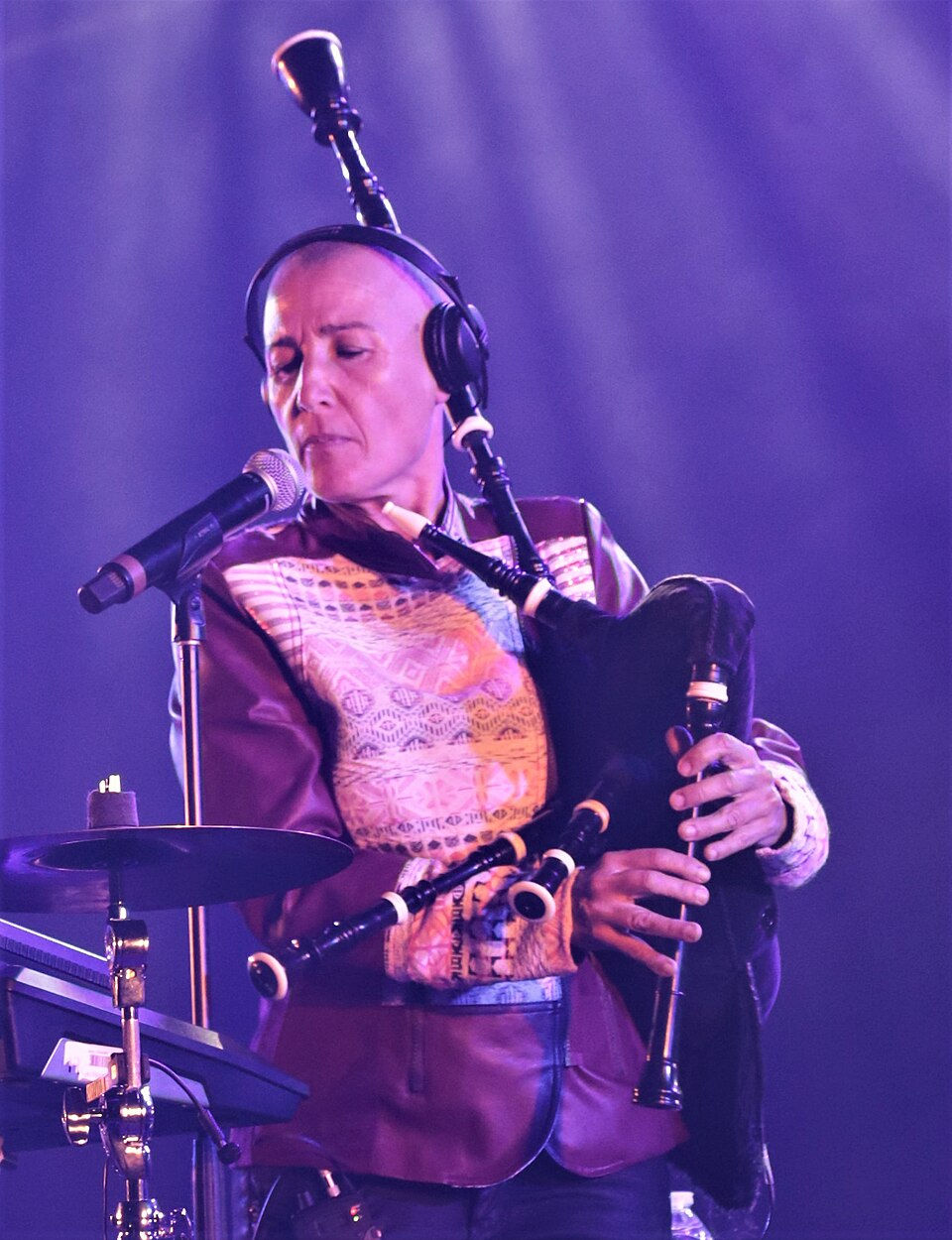
I discovered Mercedes Peón through her 2000 album Isué. The record opens with a tremendous piece. This one. The first thing you hear is a cry, the beginning of an aturuxo. Then the pandeiretas come in, the bagpipe, the bass, more percussion… Then Mercedes’ voice develops the phrases, answered by a chorus of shrill female voices. Perhaps today it would not feel quite as shocking.
We are talking about 26 years ago. Still, I believe that even now, if you have never heard what I am describing, it will surely strike you as powerful 26 years later, because it remains wonderful and innovative.
Credit of the picture: By XIIIfromTOKYO - Own work, CC BY SA 4.0, https://commons.wikimedia.org/w/index.php?curid=817401233
Mercedes combines her unquestionable artistic talent with a deep love for and knowledge of traditional Galician music, along with a remarkable boldness.
The first time I saw her live was at the Etnohelmántica festival in Salamanca, a festival that no longer exists, but where I also had the pleasure of seeing Esma Redzepova (she was a featured artist in this previous edition). My friend Felipe and I spent the whole concert taking photos from the front row for the magazine Planeta Ritmo (which also no longer exists), and after the concert we were able to join the band for a drink.
Mercedes was beginning to become somewhat known outside Galicia, but in her homeland she was already popular. She told me that she was called “a rainha do bravú”, the queen of bravú, in reference to the rock bravú movement, with groups such as Os Diplomáticos de Monte-Alto, with whom she collaborated. Listen here to the piece “Nordés”, from the 1999 album Capetón by that group. Her voice and composition were also featured in the intro of the television series Mareas Vivas (you can hear that piece here), which premiered in 1999. That TV series was hugely popular.
Her debut solo album, Isué (2000), marked a turning point in Galician roots music, combining traditional vocal forms and percussion with contemporary production and electronic elements.
~~~~
The striking music of Isué was matched by an equally striking personal image. Mercedes shaved her head, whereas she had previously worn her hair even down to her waist. Here you can see her at 26, singing incredibly and playing the pandeireta and the gaita live on Galician television:
Mercedes was born in A Coruña in 1967. She is the sister of Henrique Peón, also a singer and dancer, and founder of the Asociación Cultural Xacarandaina. He is a prominent figure in the Galician folk music and dance scene and was a member of the band Radio Cos.
Back to Mercedes: from an early age she carried out extensive fieldwork across rural Galicia, recording traditional songs directly from elderly women singers. She later contributed to the preservation and dissemination of this repertoire through the collection Raiceiras, a project devoted to documenting and publishing recordings of Galician women’s traditional singing. This deep engagement with oral sources has profoundly shaped both her repertoire and her artistic language.
She continued developing this personal aesthetic in subsequent albums including Ajrú (2003), Sihá (2007), SOS (2010), Deixaas (2018) and Ingrávida (2023).
~~~~
This other video that I have chose is of the piece “Deixaas”, from the album of 2018. The description on youtube says that "it is a metaphor anchored in the shipbuilding industry of Ferrol, a conceptualization of realities that makes the social and cultural fabric visible through a subjective sonic mapping. Realities of everyday life that exist on this platform without being aware of the existence of the whole. From the tiny sparks produced by a grinder to a critique of the social construction of gender." With Mercedes in the video there are also Ana Fernández and Mónica de Nut:
Mercedes Peón is a star and she is active and her biography is easily findable. You can check some links if you want:
Special content: Interview about the debut album by Kyiv's Kapela Zbyten
By Araceli Tzigane, with answers by the members of the band Sofiia Helanok and Andrii Paslavskyi, after a contact by Iryna Lobanok (Ukrainian Institut). The pictures in this article have been provided by Iryna.

A few weeks ago, Iryna Lobanok, mainstream music programme manager at the Ukrainian Institut, contacted us with a news from the members. It was about the debut album by the band Kapela Zbyten.
Iryna explained that "Kyiv's Kapela Zbyten band breathes life into 150-year-old Ukrainian dance melodies forgotten by time. Their debut album "Labka" features nine ancient motifs once played by blind kobzars, performed on traditional instruments—two violins, cello, tsymbaly, and frame-drum.
But this isn't a museum piece. The band plays at weddings, bars, and parties, proving centuries-old music still makes people move today. Two vocal tracks add dark humor: "Bida" follows Misfortune's journey across Ukraine, while "Kysil" tells an absurdly tragic tale of a wife's remedy that arrives too late. Listen to "Labka", where tradition meets modernity — and it dances."
Upon reading this description and listening to the music, I felt that the topic was worth exploring further, both because of the group’s compelling work and as a way to once again reflect on the situation in Ukraine. The war continues, and on the 22nd of this February it will already mark three years. I hope the time comes soon when they, and all other Ukrainian artists and citizens in general, can finally leave this nightmare behind.
While you read the interview, you can listen to the album on any of the several platforms where it is available.
➡️ Check and select your preferred one, here 🎶
The questions have been answered by:
▫️Sofiia Helanok: she is a student of the Kyiv Conservatory, traditional violin teacher, composer, sound engineer. Plays first fiddle in Kapela Zbyten.
▫️Andrii Paslavskyi: he has been engaged in the traditional music field for more than 11 years, a leading ethnologist at the Center for Folklore and Ethnography of the Taras Shevchenko National University of Kyiv, a researcher and reconstructor. Plays a cello of his own making in Kapela Zbyten.
Araceli Tzigane: How did you find the melodies?
Sofiia Helanok: The melodies that sound in the album were mostly notated by folklorist and composer Mykola Lysenko in 1874 from the wandering kobzar (musician playing a lute-like instrument “kobza”) Ostap Veresay, as well as other folklorists: Filaret Kolessa from Hnat Honcharenko and Porfiry Demutsky from Rydko Slyusar, around the same time. The materials of their sheet music collections contain mainly examples of the epic tradition, but also a small number of dances, which is what we were looking for. These collections were published at different times and are available in libraries and on the Internet.
AT: Are there still moments when these melodies are used in the environment in which they were used before?
Sofiia Helanok: Some of the melodies available in the collections are very similar to some examples known to us from 20th century recordings, but in the album we wanted to raise a new melodic layer. If we talk about the dance tradition in general, then until recently it was alive and active in the villages, often updating the instrumental composition, first from violins to accordion (harmoshka/baian), and then in some places to synthesizers. Now, due to both urbanization and a surge of interest in national culture, the dance tradition has moved to the city, in particular to the capital, where the community of old-school instrumental parties is actively growing and integrating traditional music into everyday life.
Andrii Paslavskyi: Some of the melodies were once recorded and released on CD by Volodymyr Kushpet with his students, but they are included there solo and on kobzar instruments.
AT: Have these melodies been reinterpreted and used in new environments?
Sofiia Helanok: As I already mentioned, these melodies were primarily recorded from other instruments. However, our hypothesis is that they were also popular in string and bow performance at the time (there are critically few notations of instrumental folklore of that time). So now we perform this music in the canonical composition for dance music (two fiddles, frame drum, cello, tsymbaly) and actively integrate it into its natural environment: dance parties in pubs, bars and clubs. In addition to performing in completely traditional contexts, we also work in experimental formats: some tracks from the album (as well as other dances that we play) were heard in our collaboration with noise musician Clemens Poole at the CMYK` rave and the Construction festival in Dnipro. We also recorded samples with these melodies for other electronic artists who are interested in integrating tradition into experimental music.

AT: How does the band see the future of this music?
Sofiia Helanok: I think that the classic acoustic format of music for dance is the music of the future. These rhythms are created specifically for movement, were born and honed in eternal symbiosis, and have a groove that easily competes with EDM genres. But competition does not conflict with symbiosis - tradition is alive when it is part of modernity. I very much support collaborations between traditional musicians and artists of other genres, the active use of folk music in pop culture, but I see a future in this only with deep awareness. It is very easy to turn folk into kitsch, and this will have a future only when thoughtless quoting for the sake of exoticization becomes bad manners. And for now, I prefer instrumental dance parties.
Andrii Paslavskyi: Ukrainian dance music in particular is still very little known to the average listener, but it has huge potential. In addition to its purely direct consumer use at parties, weddings, or in experimental exploration, it also has a place in the film industry, animation, advertising, and any places and formats of public spaces where there is a place for light, casual musical accompaniment, especially when it is specifically our cultural material.
AT: Is the war in Ukraine still affecting the art scene? If so, how?
Sofiia Helanok: A huge number of artists serve in the Armed Forces, in particular fiddler Klym Palij from our band. In addition to service, the war significantly complicates everyday life for civilians. We raise money for the army, manage to study, work, do household chores, etc. with a limited amount of light and running water, regularly experience stress from shelling, and worry about loved ones at the front line; of course, this exhausts both artists and the public, and chronically exhausted people cannot realize their full potential and ambitions. We constantly have an element of uncertainty and risk in the organization: any event can be canceled due to night shelling with human losses, and technical organization is significantly more complicated when you have to do a rave powered by generators. And last but not least, we cannot maintain such close contacts with foreign colleagues, we are not represented as we would like on the international stage, and the international stage is not represented here. However, I would like to end on the positive side: in times of war, you feel the need for this music the most, because you see how it unites and supports people. Dancing with flashlights in powerless clubs, festive singing in front-line villages, performances for the military, group singing and mutual support in the community - all this is strong and inspiring, and it is difficult for me to imagine such a deep and multifaceted interaction with music as we have here and now.
Andrii Paslavskyi: on the one hand, the existential war has greatly increased interest in national culture, the search for origins and their understanding. On the other hand, there is an ethical issue, because in such difficult times, musicians do not have the moral right to earn money from entertainment culture, and therefore the vast majority of public events are held to raise funds for the needs of the army. This is the least we can do to help, but all these years we have not directed the accumulated resources to the development of creativity. Still, this is not a problem, because this is a conscious choice and civic position of every responsible citizen at such a time.

AT: Why do you perform traditional music instead of other types of more potentially commercial music?
Sofiia Helanok: I do the music that I love: experimental electronics and neoclassical, Ukrainian traditional dance music, and I dream of a cabaret project soon - none of this is potentially very commercial, so probably money is just a bit far in my system of priorities.
Andrii Paslavskyi: doing exclusively what has commercial appeal is rarely about love for music, and certainly not about love for the culture of the people you belong to. This layer of culture was, and to a large extent still is, on the verge of oblivion. If we think only about money, a lot of beautiful things will disappear in this world. We play it out of respect for the generations that played it before us and out of respect for the generations that will play it after us. And this music also gives a much higher level of interaction with the audience and a sense of self. These are things that cannot be bought for any money, and which disappear very quickly as soon as too much commerce appears here. Traditional culture is utilitarian, applied, alive, and that is its whole beauty. As soon as you start making a commercial product out of utilitarian culture, it becomes soulless and empty, and turning national culture into a commodity or decoration is already the first step towards its neglect and devaluation.
AT: Do you have a personal background with traditional music (for example, in your family)?
Sofiia Helanok: None. My love for traditional music began in adulthood, when I studied vocal tradition at the conservatory and got acquainted with the community.
Andrii Paslavskyi: My great-grandfather's brother played the clarinet in a band. There are no recordings, but I knew about it since childhood. The rest of my personal background was acquired throughout life, unconscious contacts and conscious searches.
Did you enjoy any of these? Then, follow us on Facebook and Instagram and show this to anybody who could appreciate it.
HOW TO PARTICIPATE IN THIS NEWSLETTER
Are you already a member? Then, remember that you can submit contents for this monthly newsletter. Email your content to efneditors@gmail.com, for these sections:
· News from EFN Members. Brief announcements – of around 100 words and a link.
· Featured artist. - A profile with around 200 words, an embedded video and one link. Members are invited to submit profiles, considering solo and ensemble living or not living artists who have achieved lifelong artistic and technical quality or historical significance in the field of folk art from or developed in or settled in Europe. If you have any artists in mind that you'd like to feature, please ask in advance, just to be sure there is no other member already doing it.
And whether you are a member or not, you can participate in this section:
· Special sections. For instance, an interview with someone from an institution that is not a member or a thematic article by a guest writer or anything that can appear and be considered as interesting. This section can also host guest writers that are not members.
If you'd like to share any content, contact us in advance to schedule it by emailing efneditors@gmail.com
Of course, self promotional articles lacking interest won't be accepted. In case of doubt, the EFN board will be consulted and will decide.
BECOMING A MEMBER?
EFN membership is growing rapidly – why not join the network of traditional arts organisers and artists that stretches across Europe from the Irish Sea to the Baltic, the Mediterranean to the Black Sea? Find out more about membership and download an application form from www.europeanfolknetwork.com/membership.
DO YOU WANT TO SUPPORT EFN MORE?
The EFN welcomes donations. We do a lot with little money. Imagine what we can do with a little more :) Let us know how much you want to donate and we'll issue an invoice for your organization.


This story really means something to me. When I think about my time in college as a PhD candidate I get nervous about how confused I felt. I was too proud to ask for help so I did badly on my first big paper. That is why I started working part time at Last-Minute Assignments to be the kind of guide I wish I had when I was struggling. It all comes back, to me when I see students getting really upset. Sometimes it takes a lot of courage to say "do my assignment" and let someone help you with it.
I found the section highlighting upcoming collaborations and events across different countries really interesting, especially how the network keeps traditional music connected while still evolving through new projects. It’s nice to see how these newsletters bring together artists and communities that might otherwise feel quite distant from each other. I was wondering how much of the audience engagement comes from younger participants versus those already deeply involved in folk traditions.
Reading through it also made me think about how people involved in arts and culture often balance creative interests with other responsibilities. I’ve come across discussions where someone is following folk events or learning traditional music while also dealing with coursework or even looking into things like HND Assignment Help…